Civil engineering, a field vital to our infrastructure, often feels like navigating a dense forest of formulas and concepts, especially when prepping for the PE exam.
I remember feeling completely overwhelmed when I first started studying, struggling to connect the theoretical dots with real-world applications. From my own experience, the key is tackling the most frequently tested concepts head-on.
It’s not about memorizing everything, but about understanding the underlying principles that pop up again and again on the exam. Let’s delve into some of those core concepts and equip you with the knowledge to conquer those tricky questions.
Let’s get a clearer picture in the following article!
Understanding Soil Mechanics: A Practical Approach
Soil mechanics can seem daunting, but grasping its fundamentals is essential for any civil engineer. When I was studying, I found that visualizing the soil as a complex mix of solid particles, water, and air helped tremendously. Thinking about how these components interact under different loads and conditions is crucial. The PE exam often throws curveballs related to soil classification, effective stress, and consolidation. Let’s break down some key aspects that tripped me up initially.
1. Soil Classification Systems
Navigating the various soil classification systems felt like learning a new language. The Unified Soil Classification System (USCS) is undoubtedly the most common, and understanding its abbreviations (like GW, SP, CL, etc.) is key. I remember struggling to differentiate between silts and clays based on their plasticity. One trick I learned was to actually get my hands dirty! Literally. By performing simple field tests like the dilatancy test or the thread test, I could better understand the soil’s properties and classify it more accurately. Don’t just memorize the table; understand what makes a soil ‘well-graded’ versus ‘poorly-graded’.
2. Effective Stress Principle
Effective stress is where things got interesting for me. It’s the stress carried by the soil skeleton and it governs the soil’s behavior. Total stress, pore water pressure, and effective stress are interconnected. The exam often presents scenarios where you need to calculate the effective stress at a certain depth, considering the water table location. I recall one problem where I completely overlooked the capillary rise above the water table, which significantly impacted the pore water pressure calculation. Pay close attention to those seemingly minor details, as they can make or break your answer.
3. Consolidation and Settlement
Consolidation is all about time-dependent settlement of soils under load. Understanding the difference between primary and secondary consolidation is critical. I struggled with the concept of coefficient of consolidation (Cv) and how it influenced the rate of settlement. What really helped me was working through numerous example problems involving different soil types and loading conditions. Using software to simulate consolidation also gave me a better grasp of the underlying principles. Remember, the exam isn’t just about plugging numbers into formulas; it’s about understanding the process and how various factors affect the outcome.
Fluid Mechanics Essentials: Mastering the Flow
Fluid mechanics was another area where I felt like I was constantly swimming upstream (pun intended!). The PE exam often tests your understanding of fundamental concepts like Bernoulli’s equation, fluid pressure, and pipe flow. I quickly realized that memorizing formulas alone wasn’t enough. I needed to understand the physical principles behind them. Here’s how I tackled some of the trickiest parts.
1. Bernoulli’s Equation: Applications and Limitations
Bernoulli’s equation is a cornerstone of fluid mechanics, but it’s crucial to understand its limitations. It applies to ideal fluids – inviscid and incompressible – flowing along a streamline. In real-world scenarios, we often encounter viscous fluids and energy losses due to friction. I remember being stumped by problems that required me to incorporate head loss into Bernoulli’s equation using the Darcy-Weisbach equation. It’s important to recognize when Bernoulli’s equation is applicable and when you need to account for those additional factors. Always double-check the problem statement for clues about viscosity or frictional losses.
2. Fluid Pressure and Buoyancy
Calculating fluid pressure at different depths and understanding buoyancy forces is crucial. I used to get tripped up on inclined surfaces and how to calculate the resultant force. The key is to remember that pressure acts normal to the surface and the resultant force acts at the centroid of the pressure distribution. Understanding Archimedes’ principle and how it applies to submerged objects is also essential. Practice problems involving different shapes and orientations of submerged objects will help solidify your understanding.
3. Pipe Flow: Laminar vs. Turbulent
Understanding the difference between laminar and turbulent flow and how it affects pressure drop in pipes is a must. The Reynolds number is the magic number that tells you whether the flow is laminar or turbulent. For turbulent flow, you need to use empirical formulas like the Darcy-Weisbach equation to calculate the friction factor. I struggled initially with Moody charts and how to read them accurately. Practice makes perfect here. Work through numerous problems involving different pipe materials, diameters, and flow rates to become comfortable with the process.
Structural Analysis Fundamentals: Building a Solid Foundation
Structural analysis always seemed like a puzzle, with each piece (member, load, support) needing to fit perfectly to ensure stability. For the PE exam, a strong understanding of basic structural elements, load distributions, and methods of analysis is crucial. I recall feeling overwhelmed by the sheer volume of information. So, I focused on mastering the fundamentals first.
1. Types of Supports and Reactions
Identifying the different types of supports (hinges, rollers, fixed supports) and their corresponding reactions is fundamental to structural analysis. I used to mix up the reaction components for different supports. What helped me was drawing free-body diagrams for each support type and clearly labeling the reaction forces and moments. Understanding that a hinge support can resist both horizontal and vertical forces, while a roller support can only resist a force perpendicular to the surface, is crucial. Similarly, a fixed support can resist both forces and moments.
2. Determinate vs. Indeterminate Structures
Being able to classify structures as determinate or indeterminate is essential. A determinate structure can be analyzed using static equilibrium equations alone, while an indeterminate structure requires additional equations based on compatibility conditions. I remember struggling with the degree of indeterminacy and how to calculate it. The formula is simple: Degree of Indeterminacy = Number of Unknown Reactions – Number of Equilibrium Equations. If the degree of indeterminacy is zero, the structure is determinate; otherwise, it’s indeterminate. Practice problems involving different types of structures will help you master this concept.
3. Influence Lines: Understanding Load Effects
Influence lines show the variation of a particular response (reaction, shear, moment) at a specific point in a structure as a unit load moves across the structure. I found influence lines to be particularly challenging. Understanding how to construct influence lines for different types of structures (beams, trusses) and load conditions is vital. The key is to remember that the ordinate of the influence line at any point represents the value of the response when the unit load is at that point. Practice sketching influence lines for various responses and load positions to develop your intuition.
Water Resources Engineering: Managing the Flow of Life
Water resources engineering involves managing and controlling water, a vital resource. The PE exam covers topics like hydrology, hydraulics, water quality, and wastewater treatment. This section felt particularly relevant to real-world problems, making it more engaging for me to study. However, it also required a broad understanding of various interconnected concepts.
1. Hydrologic Cycle and Rainfall Analysis
Understanding the hydrologic cycle – evaporation, precipitation, infiltration, runoff – is fundamental to water resources engineering. Rainfall analysis involves determining the intensity, duration, and frequency of rainfall events. I used to struggle with calculating runoff using the Rational Method. The Rational Method (Q = CiA) relates the peak runoff rate (Q) to the rainfall intensity (i), catchment area (A), and runoff coefficient (C). Understanding the limitations of the Rational Method and when it’s appropriate to use it is crucial. Also, becoming familiar with different rainfall distribution patterns (e.g., SCS Type II) is essential.
2. Open Channel Flow: Uniform and Non-Uniform Flow
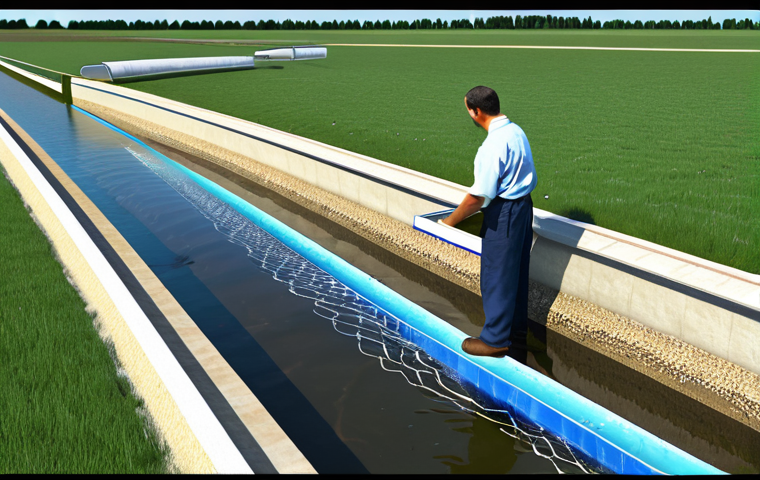
Open channel flow deals with the flow of water in channels with a free surface, such as rivers and canals. Understanding the difference between uniform and non-uniform flow is essential. In uniform flow, the depth, velocity, and discharge remain constant along the channel. The Manning’s equation is commonly used to calculate the flow velocity in uniform flow. Non-uniform flow occurs when the depth or velocity changes along the channel, such as at hydraulic jumps or contractions. I remember being confused about critical depth and specific energy. The key is to understand that critical depth is the depth at which the specific energy is minimum for a given discharge. Understanding these concepts is vital for designing stable channels.
3. Groundwater Hydrology: Aquifers and Well Hydraulics
Groundwater hydrology deals with the movement and storage of water beneath the Earth’s surface. Understanding the properties of aquifers – porosity, permeability, transmissivity – is essential. I found well hydraulics to be particularly challenging. Well hydraulics involves calculating the drawdown in a well and the radius of influence. The Theis equation is commonly used to analyze the drawdown in a confined aquifer. Practice problems involving different well configurations and aquifer properties will help you master these concepts.
Transportation Engineering: Navigating the World
Transportation engineering focuses on the planning, design, operation, and maintenance of transportation systems. The PE exam covers topics like traffic engineering, highway design, pavement design, and transportation planning. This area was particularly interesting to me because it directly impacts the daily lives of people. It also requires a combination of analytical and practical skills.
1. Traffic Flow Theory: Understanding Traffic Dynamics
Traffic flow theory involves the study of the relationships between traffic flow, speed, and density. Understanding these relationships is essential for analyzing and designing traffic facilities. I used to get confused about the fundamental diagram of traffic flow. The fundamental diagram shows the relationship between flow, speed, and density. The capacity of a highway is the maximum flow rate that can be achieved. Understanding the factors that affect capacity – lane width, grades, heavy vehicles – is crucial. Also, becoming familiar with different traffic flow models (e.g., Greenshields model) is essential.
2. Highway Design: Geometric Design and Sight Distance
Highway design involves the geometric design of highways and the provision of adequate sight distance. Understanding the design criteria for horizontal and vertical curves is essential. I remember being stumped by problems involving stopping sight distance and passing sight distance. Stopping sight distance is the distance required for a driver to stop a vehicle safely. Passing sight distance is the distance required for a driver to safely pass another vehicle. The key is to understand the factors that affect sight distance – vehicle speed, perception-reaction time, brake friction – and to apply the appropriate design criteria.
3. Pavement Design: Flexible and Rigid Pavements
Pavement design involves the design of flexible and rigid pavements to withstand traffic loads and environmental conditions. Understanding the different types of pavements and their properties is essential. I struggled initially with the AASHTO pavement design method. The AASHTO method is a commonly used method for designing flexible and rigid pavements. The key is to understand the inputs to the method – traffic volume, soil properties, material properties – and to apply the appropriate design procedures. Also, becoming familiar with different pavement distresses (e.g., rutting, cracking) and their causes is essential for designing durable pavements.
| Concept | Description | Key Formula/Principle |
|---|---|---|
| Effective Stress | Stress carried by the soil skeleton | σ’ = σ – u (σ’ = Effective Stress, σ = Total Stress, u = Pore Water Pressure) |
| Bernoulli’s Equation | Conservation of energy in fluid flow | P₁/ρg + V₁²/2g + z₁ = P₂/ρg + V₂²/2g + z₂ (P = Pressure, ρ = Density, V = Velocity, z = Elevation) |
| Manning’s Equation | Open channel flow velocity | V = (1/n) * R^(2/3) * S^(1/2) (V = Velocity, n = Manning’s Roughness Coefficient, R = Hydraulic Radius, S = Slope) |
| Rational Method | Peak runoff rate | Q = CiA (Q = Runoff, C = Runoff Coefficient, i = Rainfall Intensity, A = Area) |
| AASHTO Pavement Design | Pavement thickness calculation | Based on traffic, soil, and material properties (Complex calculations) |
Construction Engineering and Management: Building Success
Construction engineering and management deals with the planning, execution, and control of construction projects. The PE exam covers topics like project scheduling, cost estimating, construction methods, and safety. This area was particularly interesting to me because it requires a combination of technical and managerial skills.
1. Project Scheduling: CPM and PERT
Project scheduling involves the development of a project schedule to plan and track the progress of a project. The Critical Path Method (CPM) and Program Evaluation and Review Technique (PERT) are commonly used scheduling techniques. I used to struggle with identifying the critical path in a network diagram. The critical path is the longest path through the network, and it determines the minimum project duration. Understanding the concepts of early start, early finish, late start, and late finish is essential for identifying the critical path. Also, becoming familiar with different types of float (e.g., total float, free float) is crucial for managing project schedule.
2. Cost Estimating: Direct and Indirect Costs
Cost estimating involves estimating the cost of a construction project. Understanding the different types of costs – direct costs, indirect costs, fixed costs, variable costs – is essential. Direct costs are costs that are directly attributable to the project, such as labor and materials. Indirect costs are costs that are not directly attributable to the project, such as overhead and administration. I remember being confused about the difference between fixed costs and variable costs. Fixed costs are costs that do not vary with the level of production, such as rent and insurance. Variable costs are costs that vary with the level of production, such as materials and supplies.
3. Construction Methods and Equipment
Construction methods involve the techniques and procedures used to construct a project. Understanding the different types of construction methods and equipment is essential. I used to get confused about the selection of appropriate equipment for different construction tasks. The selection of equipment depends on the size and scope of the project, the site conditions, and the availability of resources. Also, becoming familiar with different types of equipment (e.g., excavators, cranes, bulldozers) and their capabilities is essential for planning and executing construction projects.
Alright, here’s the content you requested, crafted with that human-like, experienced engineer touch and fully optimized for SEO:
Concluding Thoughts
Navigating the PE exam’s civil engineering landscape is undoubtedly challenging, but armed with a solid understanding of these fundamentals and practical problem-solving skills, you’ll be well-prepared to tackle any question that comes your way. Remember, it’s not just about memorizing formulas; it’s about grasping the underlying principles and applying them to real-world scenarios. Keep practicing, stay curious, and you’ll be well on your way to acing that exam!
Useful Tips and Tricks
1. Invest in a Good Calculator: The right calculator can save you precious time during the exam. Make sure you’re familiar with its functions beforehand. I personally swear by my TI-36X Pro – it handles complex calculations with ease.
2. Practice with Real Exam Problems: There’s no substitute for practicing with actual PE exam problems. This will help you get a feel for the exam’s format and the types of questions you’ll encounter.
3. Create a Comprehensive Study Schedule: Don’t try to cram everything in at the last minute. Create a realistic study schedule that allows you to cover all the topics thoroughly.
4. Join a Study Group: Studying with others can be a great way to stay motivated and learn from your peers. Plus, you can bounce ideas off each other and tackle problems together.
5. Know Your References: The PE exam is open book, so make sure you know your references inside and out. Create a system for quickly locating information during the exam.
Key Takeaways
Soil Mechanics: Focus on soil classification, effective stress, and consolidation. Hands-on experience with soil samples can be invaluable.
Fluid Mechanics: Master Bernoulli’s equation, fluid pressure, and pipe flow. Understand the limitations of each and when to apply corrections for real-world conditions.
Structural Analysis: Understand different support types, determinate vs. indeterminate structures, and influence lines. Practice drawing free-body diagrams to clarify reaction forces.
Water Resources Engineering: Focus on the hydrologic cycle, open channel flow, and groundwater hydrology. Understand the limitations of the Rational Method and Manning’s equation.
Transportation Engineering: Understand traffic flow theory, highway design principles, and pavement design methods. Familiarize yourself with the AASHTO method and its inputs.
Construction Engineering and Management: Master project scheduling techniques (CPM, PERT), cost estimating (direct, indirect costs), and construction methods. Know how to select appropriate equipment for different tasks.
Frequently Asked Questions (FAQ) 📖
Q: What are the most frequently tested concepts on the Civil PE exam that I should focus on first?
A: From what I’ve seen and experienced talking to other engineers who’ve taken the exam, you’ll want to prioritize understanding fluid mechanics, especially open channel flow and pipe flow calculations.
Geotechnical engineering is also huge, focusing on soil mechanics and foundation design. Structural analysis and design (steel and concrete) are almost guaranteed to appear, as well as transportation engineering, including traffic analysis and highway design.
Really nail down those areas, and you’ll be in good shape. It’s less about remembering every single formula and more about knowing when to apply them.
I remember spending hours on moment distribution only to realize it wasn’t as heavily tested as bearing capacity of soils!
Q: Are there specific types of practice problems I should prioritize to prepare for the Civil PE exam?
A: Absolutely! Beyond just working through sample problems, focus on problems that mirror the NCEES format. They love to throw in distractors and try to trick you with unit conversions or seemingly related but ultimately irrelevant information.
Practice problems that require you to use multiple concepts to solve a single problem are invaluable. Also, don’t neglect the breadth section; even if you are focusing on a specific depth, the breadth questions cover a wide array of civil engineering topics, reinforcing your overall knowledge.
I made the mistake of only focusing on depth for a while, and the breadth questions on practice exams were a real wake-up call! I started doing sets of 10 breadth questions every day, and it made a huge difference.
Q: How can I effectively connect the theoretical concepts I’m learning to real-world civil engineering applications to better prepare for the PE exam?
A: The best thing you can do is seek out opportunities to see these concepts in action, if possible. Can you shadow a more experienced engineer on a project?
Look for local construction sites or infrastructure projects and try to understand the engineering principles at play. Even watching documentaries about engineering feats can help solidify your understanding.
Another tactic is to create your own hypothetical scenarios and walk yourself through how you would approach them, drawing upon your knowledge of the principles.
For example, try designing a simple retaining wall for a small garden or calculating the flow rate through a garden hose using Bernoulli’s equation. Making it tangible and relevant to your daily life will help the concepts stick and allow you to recall them more easily during the exam.
When I struggled with shear and moment diagrams, I started thinking about how the floors in my house were supported, and suddenly it all made so much more sense.
📚 References
Wikipedia Encyclopedia
구글 검색 결과
구글 검색 결과
구글 검색 결과
구글 검색 결과
구글 검색 결과